• The dream

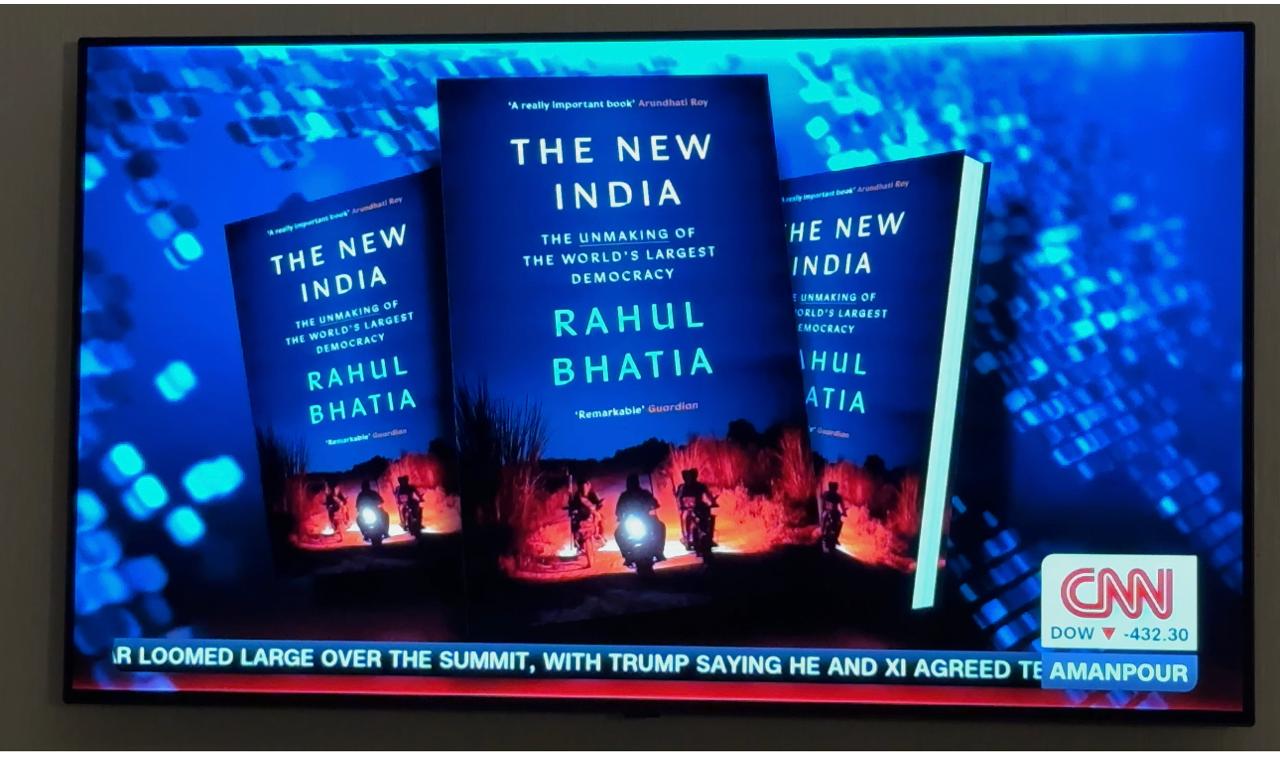
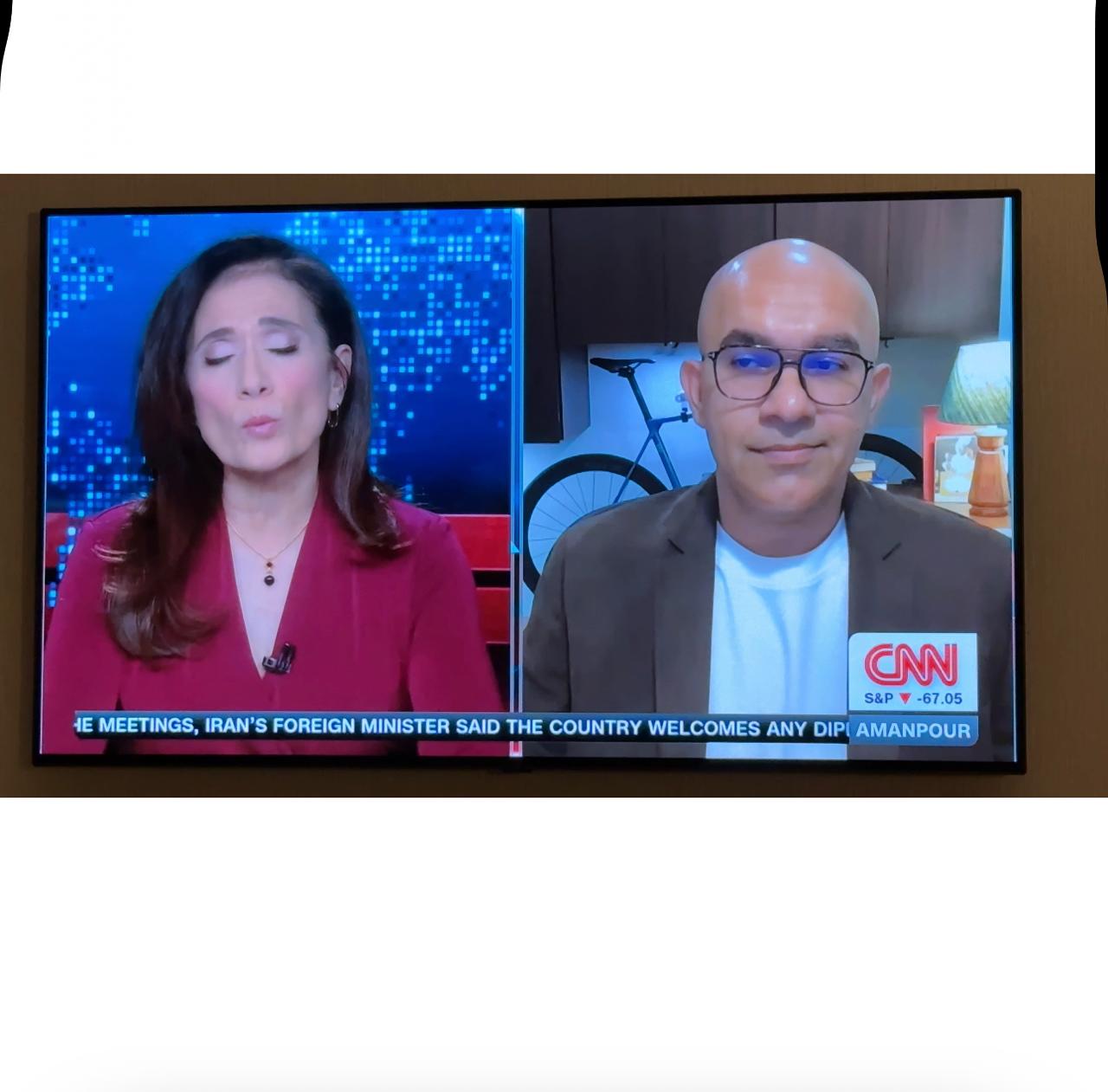
    Listen, I grew up watching Christiane Amanpour, so pardon me for my excitement about being interviewed for her show. The interview was 18 minutes long. That’s eighteen. And it wasn’t just about the Bengal election results, but also about the book. (18 months after its release!) How, man? Anyway, it was a milestone, and I gleefully shared it with family elders who watched her through the Gulf wars in the ’90s and ’00s. I’m told everything has been forgiven and they love me again.

    Here it is: https://edition.cnn.com/2026/05/15/tv/video/amanpour-newton-bhatia-india

  • Questions to authority

    Two nights ago I attended the launch of [In]Complete Justice?, S Muralidhar’s book of essays about the state of India’s Supreme Court, which turns 75 this year. The hall at India International Centre brimmed with senior advocates, journalists, and politicians soon after six that evening. By the time the event began—a conversation between J. Murali, J. Abhay Oka, and professor Gopal Guru—the room’s sides and back were lined with junior advocates who had sacrificed their seats for their senior.

    I was curious. I had first read about Muralidhar on the morning of 26 February 2020, in a story describing his urgent constitution of a bench at midnight during three days of communal violence in north-east Delhi stoked by BJP leaders. He ordered the police to and ensure that victims of the violence were allowed safe passage to medical treatment. Later that morning, he questioned the Delhi police’s inordinate delay in registering first information reports against three BJP leaders for hate speech.

    I remember that day because reading his orders, his instructions, his observations about the police, about the conduct of the police and lawmakers—and understanding everything that it implied—filled me with unusual hope. Here was a time in which people of every rank and stripe defaulted to cowardice they called caution, as if what went on in the country had nothing to do with them (the ignorance of people who understand tyranny as a shadow to step around, not as a bottomless well of dark ink that blots and blots and blots, blotting memories and laws and history and science and moral clarity). Here was a time when calling a thing by its name was met with the state’s punitive energies.

    And in this dark time was a judge, finally, finally, whose notions of right and wrong, of the obvious lines crossed, felt like my own. You have to sense people like these in authoritarian places for they tend to be quiet, they tend to keep doing their thing in isolation, in a haze of oppressive loneliness, utterly at the mercy of a bureaucracy unlike any of the past, for its utter stupidity has no comparison in living memory. These people, many of whom I met while writing my book, and who I still meet, are dissimilar in many ways, but they tend to possess an underlying moral system, a collection of ideas and experiences that keep them going, and a kind of manic personality that swings between extreme hope and despair, with the occasional pause at mad laughter. They keep their head down (researchers), they entrust their fate to people who can bring about the end of long careers—but they push, and push, to understand and inspire others to look harder.

    Muralidhar was in the light, and on the night of the 26th, the order for his transfer from the Delhi High Court to the Punjab and Haryana High Court came in. The authorities said it was routine. Retired justices would later say that he was punished. But there is a world outside authority’s clarifications and the judgements of judges, and its verdict, largely, was rotting fish. Muralidhar departed a week later, and the halls of the Delhi High Court were filled with people who knew. (Just look at this picture. Also, this farewell video. Who gets farewells like these?)

    The book launch was more than an event. It was a gathering to understand the court’s ways and dysfunctions. The panelists spoke for forty minutes. There was laughter, there was remembering, there was acknowledging the obvious. And then, when it was finally over and opened to the audience for questions, it truly sprang to life. What life: for twenty frenetic minutes, in which the moderator, Manisha Pande, was bewildered by the persistence of the judges’ interrogators, I was reminded of how much communication flows one way in this country, and of how refreshing it is to hear real dialogue—angry, questioning, doubtful, skeptical dialogue—on the rare occasion that the generally silent are handed the mic.

    Indira Jaising began; ballistic missiles disguised as questions at a distance of five meters. Why, she asked, did the collegium elevate a high court judge from Gujarat to the Supreme Court despite a justice’s objections? What were the justice’s exact objections? Where was the transparency in such matters?

    [Nervous laughter, clenched bums. This crowd—which gives up its seats to senior advocates and almost bows in the presence of these judges—was unsure of how to respond, at first. (I was cackling, and more awake than I’d been in weeks.)]

    There was some attempt at a response. The gist of it was that transparency was necessary. Weak. The book’s editor stood to one side with a big smile.

    Then a (former, I think) BBC correspondent rose with a long preamble about women’s safety and a story about a passenger who [“is there a question here,” Pande asked] requested a different seat because she offered namaaz on the flight. How would the judges ensure women’s safety and [we’re here to talk about the book, Pande said, as the mic was retrieved]…

    Perhaps not the place, nor the time, but beside the stage, a woman wearing a headscarf covered her mouth and nodded yes! I took it to mean, you said it. You actually told them what happens.

    Then someone else, aggrieved and despairing and fed up, rose and demanded to know why Justice Oka had ruled a case from 35 years ago a certain way, and why the facts in the decision were a departure from the facts as he understood them. The justice said he would not explain himself, which earned him enthusiastic applause, but the man’s fury would not be abated. The mic was taken from him too, but it was some time before he settled down.

    That night I thought about discontent, about how rarely Indians find opportunity to question power, and how much dissatisfaction we do not see. Given an opening, it pours out, this unwillingness to forget or forgive a slight, an impropriety, a procedural violation. We are surrounded by media, but not the assurance that our discontent will be tolerated, and so we rarely hear it. Here, the moderator, whose work was to control the flow of the conversation, saw chaos. But stop, and really listen, and you’ll see what I saw, that the chaos and the discussion were about the same things: a deep desperation for accountability. There’s a recording somewhere, and I urge you to listen to Muralidhar, and then skip forward to the questions.

    Here’s what you won’t see. After it was done, the woman in the headscarf walked up to the BBC correspondent and introduced herself. I left the room later, and might have caught a glimpse of them then. They were deep in conversation.

    We’re dying to find our tribe.

  • On importing self-deporting excellence

    These days, disbelief is my usual reaction on waking up and reading the news from America. The attack on universities in particular is extraordinary, even though I understand it from the perspective of diffusing the sound of discontent over Palestine, and of turning institutions into vassals. Outside university there are the economic considerations that regulate the morals of working people, the levers and guillotines of upcoming payments and insecure work, the dues seen and unseen, that constant whisper in ears to consider the fallout of a hastily expressed opinion, and think of the many ways a revelation may be used. But what could unruly university students possibly fear when there are no jobs to be lost, no real price to be paid for an opinion in a place where opinions are the fuel of understanding. Taking it away is the price of it: The abrupt end to the classroom, the confiscation of access to what a university offers, along with the debates and disagreements and the granting of the freedom their mind was assured; the idea of the university itself, where inside is freedom, outside is the prison.

    I think, on occasion, that this is not the United States, this is how the Middle East would approach ideas—with fear, suspicion, and the intent to discipline wildness. But I remember that this is wrong: in October 2001, at an airport in Oklahoma, I’m asked in a small room by two men from law enforcement, “How do you know about Al-Qaeda?” When I tell them that I read, that college students talk about things, that—naively, I say—there is nothing wrong in it, they are contemptuous. “You people live in a bubble,” one says. When I wake up and read the news now, I see that men with minds like theirs are inside universities. There is no bubble. And I imagine that to survive here now is the adopt the Middle East rules that migrants from the subcontinent imagine keep them safe: head down, keep working, make money, rise quietly. The problems of speech, propriety, and genocide are the concerns of other people, people who have accumulated enough to forget fear, people who cannot be asked to “self-deport.”

    Authoritarianism sucks the air out of a vibrant culture. It makes smaller the numbers who consider themselves entirely safe, and makes larger the cost of expression. It goes unnoticed that the burgeoning market for nostalgia is at the cost of market for modernity. It erodes trust, and corrodes ties that hold things together. Jason Stanley, the Yale professor who left for the University of Toronto, told the Financial Times, “I believe in the values of academic freedom and defending democratic institutions, not the idea that the proper response to authoritarians is to hide and hope you’re not next.”

    Momodou Taal, a doctoral candidate at Cornell who participated in protests and filed a suit to stop the deportation of protestors, chose to leave the country because “given what we have seen across the United States, I have lost faith that a favourable ruling from the courts would guarantee my personal safety and ability to express my beliefs.”

    So there’s some kind of flight from America. The FT story talks about it, and there’s this column by Ed Luce. “American scientists are looking for jobs abroad,” he writes. “Trump has presented the world with a giant poaching opportunity.” This is what I’ve been in disbelief about every morning—the idea of job cuts and research funding drying up, and of this country’s giant talent pool looking for a new home. And then, to put this whole post in context, for a moment, I entertain the idea that India might welcome them, and make surprising progress in some field or the other. But we’ve had silence in this regard, no evidence of any thought given to the opportunity. It’s fitting, given the well-established governmental antipathy to expertise of any kind, but still dismaying. I studied the RSS for a few years, and wrote about their dedication to obfuscation. Now, with them at the center of political life, the country is unable to use this moment to invite talent, because it’s at war with what they have to offer. They fear the meandering that brings independence. Explorations must be officially approved.

    What a time to choose ignorance.

  • NYT and NPR pick The New India

    Bloody hell.

    The New York Times and NPR *both* have The New India (The Identity Project) on their year-end books list.

    The NYT has something called 100 Notable Books, which I was vaguely aware of until 8.14pm yesterday and then incredibly aware of by 8.16pm. Going down the list of titles yesterday, I saw my friend Nilanjana Roy’s fantastic Black River on it and rang her up immediately to break the news. I returned to the list and then noticed The New India among the nonfiction picks.

    This happened a day after it was picked for NPR’s end of year ‘Books We Love‘ by Diaa Hadid, who was quite generous.

    I have screenshots in case they take it back.

  • Review: Washington Monthly on The New India

    The book has its first review in the US, and I’m happy to say it’s a very good one. I wondered if American reviewers would find echoes of their own struggles with extremism in the book, and if they would look at the century-old project of turning India into a Hindu state and see how a possible radicalisation of their own population would occur. I was thrilled to see exactly this aspect of the book highlighted in the first review, in Washington Monthly.

    For Americans, The New India will resonate. India and the United States are very different countries with unique political dynamics; India, for example, does not have the same amount of polarization. But many of the forces that Bhatia describes are also found here. The New India, then, is both a chronicle and a cautionary tale: an illustration of how easily societies can be poisoned.

    I was also pleasantly surprised by the close reading of India’s politics, and the role disinformation plays in creating an atmosphere of suspicion. He read it, and I’m so relieved he picked up the relevance of certain narrative strands and connections between them in the book. For example, the 1920s idea that Hindus were under attack is tightly wound with the kind of misinformation people receive on their phones in 2024.

    This notion—that Hindus are under attack by Muslims—is present throughout Indian politics. It is propagated by many of the country’s leaders, who seek to whip up the population into an anti-minority frenzy that they can use to maintain power. Truth, Bhatia notes, is a weak obstacle to these aims. Ethnic entrepreneurs can almost always find anecdotes that inspire enough fear to overcome the broader factual picture. Muslims, for example, are not any more violent than Hindus. They do not aspire to displace India’s overwhelmingly large Hindu population. But revanchists are skilled at finding anecdotes in which a Muslim did attack a Hindu, and then amplifying these stories across the entire nation.

    Such actors, of course, also succeed by spreading outright disinformation. Hindu nationalists, Bhatia writes, are adroit at “creating an atmosphere of suspicion through the publication and repetition of rumours and suggestions”: that Muslims engage in ritualistic animal slaughter, that they are intolerant of other religions, that they are marrying and forcibly converting thousands of Hindu women. By constricting the free press, the BJP has made it hard to dispel these rumors. In India, most major media outlets are dependent, at least to an extent, on advertising by the government or companies close to it. The BJP is thus able to bring journalists in line simply by threatening their finances.

    Overall, while the months after the book’s release have been a strange combination of expectation and a somewhat empty sensation (I think the exhaustion of the last decade is catching up pretty quickly), along comes a review like this and I’m just surprised that someone read the book so closely. It’s genuinely weird for me: I wrote the book, and want people to read it, but braced myself that no one would.

    That said, buy the book here.

  • An interview with Giles Brown of Talk Radio Europe

    I can see why they call it talk radio. The interaction is unmediated, and the quiet lulls are a lubricant for conversation. There’s something of the blank canvas about radio—absolutely anything is possible.

    I might have gone on a bit about the book.

  • One man’s story of leaving Hindu nationalism

    There’s an extract from the The New India in the Guardian. It’s about a writer named Partha Banerjee who joined the RSS when he was six, and left when he was a young man. It’s a story about a father and a son, and the role the organisation played in their lives. But there are other things Partha talked to me about. He explained how minds were shaped and families won over by the RSS, and what it took to finally see what he had been a part of.

    There was work, but little if any money for the rank and file, Partha said. The cost of Jitendra’s commitment to the RSS was borne by his wife and children. “My father gave up everything, a good academic career, a decent well-to-do family, their homes, mortal pleasures, everything,” Partha told me. “My mother suffered greatly because of that. I suffered greatly because of that. We ended up living in poverty all our lives. But that was the RSS.”

    That was the RSS. The organisation’s members placed great store by suffering, maintaining not only a ledger of their own sacrifice but a complete accounting of everyone they knew. Years after Partha followed his father into the RSS, and then wrote his way out of it, he too was touched by this habit. And so while he remembered his father ignoring his financial responsibilities, and remembered that other members also “starved sometimes”, he saw nobility in a voluntary renouncing of comfort. “They were not greedy, they were not liars, they were not corrupt,” he said. “They were like saints.”

    That was why he became a member and stayed with them for decades. He wanted me to understand that while he did not support Islamophobia, disparaging Dalits and gender discrimination, the people he knew who formed the RSS’s most loyal cadre “were very honest personally”. The purity of their hatred was the result of “following their own doctrines honestly”, he said. Another former RSS volunteer told me something similar: “They peddled hate, but did it very, very sincerely. It was almost like God’s work.”

    Read the whole thing.

  • The Journalist

    [I wrote this chapter three years ago for the book, but it didn’t fit anywhere so we discarded it. This is a first draft, and therefore filled with all kinds of terrible errors.]

    “Let’s go to the graveyard, sir,” O said as we strolled through Okhla’s alleys one October night. Sure, I said. I wanted to see everything.

    He turned left or right at some junction, walked down some alley, and took some more turns. We were silent, but pebbles crunched beneath our feet, rickshaws and motorcycles roared long after they passed us, and distant shop shutters crashed down, marking the end of the day. The narrow corridors between buildings were nearly empty, and even the lovers had left. Only small groups of boys sat around on their bikes, looking to be adored. Buildings with tiled surfaces almost touched, and cables dangled like joyless decorations. If the place was scrutinised for broken laws, they would be found in every unauthorised structure, every uneven step, every open drain.

    When we came to one edge of the ghetto, O clutched his camera tight and leaped across the busy lane in his flip-flops. (He went with it everywhere in case something unusual happened.) The graveyard was unlit, and the gravekeeper, who was preparing to sleep on a khatiya in the open air, was startled by our silhouettes. He jerked up and cried, with no trace of sleep in his voice, “Who are you? Why are you here?” We told him about ourselves in soothing tones, and he relaxed. He explained that men arrived at night to break graves. His eyes were large and set in a frightened state. We meant him no harm, we said; although it was late, we wondered if we could see an old friend. He knew the person, and led us there in the dark, telling us his life’s story on the way to the burial site, leaving out no detail, including his brother’s scheming. The qabristaan was not large, and I was surprised by how little of the noise outside penetrated it.

    A plot in Okhla Qabristaan was a final reward for teachers at Jamia Millia Islamia, which bordered the graveyard. We lit phone torches to avoid stepping on the former staff. But time had eroded where they lay, and we must have stepped on their toes or hands. In any case, just in case, I apologised quietly with each step. Earlier that year, Jamia made an exception for Danish Siddiqui, a graduate of the university. A cloth lay over the grave into which he had been lowered just three months earlier, in July. Siddiqui had been travelling with soldiers in Afghanistan when a rocket-propelled grenade exploded outside his car. It was the sort of close encounter that an editor could have used as justification to order he return. Siddiqui believed it was safe enough for him to keep working, and his editors at Reuters agreed. But a journalist is at once the best person and the worst to calculate personal risk. Siddiqui had moved from danger to danger in recent years, from the Myanmar border to the protests in Hong Kong, to covering mobs in Delhi to recording the virus’s devastation. By the time he left for Afghanistan, the world was wilder. After a gunfight the next day, as Siddiqui had his wounds dressed, Talibani fighters overran the neighbourhood, and the soldiers with whom Siddiqui had been embedded retreated without him. Siddiqui was found and shot.

    People who hadn’t met him said they took days to get over their grief. Within hours of his death, anonymous supporters of the government, thoughtless as always, sent pictures of his body to anyone who remembered him fondly. The act was vengeful, full of mocking and glee, for Siddiqui had pointed his camera at a cremation ground from a rooftop, and the wire service he worked for sent images of little fires burning in every part of the frame across the world. It exposed the lie that the pandemic had been managed well in India. And then it was Siddiqui on the ground, and they, the men and women who derived their strength from being faceless and nameless, called it karma, and took pleasure in seeing him in that state: this is what happens when you don’t respect the dead was their general tone. Journalistic work set them on edge, for they thrived in the twilight between information and rumour, and journalism cut right through. They preferred official numbers to the evidence of their eyes, to their own lived experiences. They demanded evidence for claims contrary to the government’s assertions, and if this was provided they found something else to moan about. Siddiqui’s pictures in India set them on edge. His work, especially his pictures of mass cremations, was irrefutable evidence of disquiet and a loss of control, in contrast to the government’s claims of peace and competence. Worse still, in their eyes, he was Muslim.

    Punjabi music played beyond the walls. “A girl came here a few days ago,” the gravekeeper said when we arrived at the grave. “She said she was a reporter. She kept something on his stone.” He had sprinkled red chilli powder on the mound’s perimeter to keep rats from desecrating the grave.

    “There was a yellow cloth here. Who put a red one?” O wondered.

    “This I don’t know, sir,” he replied. “Why don’t you stay here? I’ll go off to one side.”

    When the digger left, O pointed to a distant gate. “That’s where they brought the body from. The place was filled with media. This man, who attended hundreds of thousands of funerals… I never imagined his funeral would be like this. How many assignments he did. I’ve come here five or six times in three months. The body must have dissolved by now. You know, he had worked on a story on a doctor in Bihar, and even though the doctor was a supporter of the BJP, he came to see him here and cried.”

    I stood above his grave, uncertain about what to do, but stilled myself and thought of him. We had first met in 2016, after the lynchings began, and at our desk in the wire service where he was a man reporters clearly loved, he spoke about creating a visual record of the trail of Muslims who had been killed. My memory is unreliable here, but he spoke of creating a poster with their faces forming a composite picture; the thought was unusual, more so in an agency that assessed its reporters’ performance by the seconds they saved. But Siddiqui did not ask for editorial permission to linger on people, he went where they were. And in following people in this country, and finding them where they lived, Siddiqui found ordinary people in stretchers, bandaged, crouched on roads while sticks landed on them. His eye was on the present, of what was important at that moment—that was why pictures of his body were circulated, I thought.

    O looked down, and then away. The gravedigger was nearby, babbling.

    “Take care of this one,” O said to him.

    “I take care of all of them very much,” the gravedigger said.

    O looked about and saw pristine stone covers over some mounds. Their shine was dimmed by dust. “I want to do that for him,” he said. The gravedigger dissuaded him. There was no use, he said, for the stones would be stolen. Men often arrived at night to take away what was not nailed down. He told us about a recent encounter. “They took out a knife this long,” he said, his left hand placed high up on his right forearm, “we struggled.”

    “Did you get hurt?” I asked him.

    He looked surprised. “I was a wrestler. Look, they even fired a bullet at me,” he said, undoing his kurta buttons to show us a dark spot on his chest. “Thanks to my locket half the bullet went in but half stayed out. I haven’t gotten an operation done because I don’t have enough money. No sir, I haven’t done it, sir. I don’t have a single rupee, sir,” his voice grew louder and more distressed. “The people who run this place don’t give me anything, sir. I get by with the twenty-thirty that people give me, sir.”

    We thought he would ask for money, but he walked with us toward the graveyard gate quietly. Just as I thought we were free, the gravedigger stopped at a wild thicket that had some significance for him. “Every year there’s a snake that comes here, drinks the milk I leave for her, and goes away. Her time is coming soon. I have to clean the bushes,” he said, and walked back to his bed.

    It was late, but people were reluctant to let go of their city. Religious songs rang out of e-rickshaws, there were muffled Punjabi beats from passing cars. Electronic carts lit in purple lights played unfamiliar music on the roadside. I followed O past Freedom Fighter Fountain, a local landmark. The promise of spectacle is implicit in a memorial for freedom fighters, but this was part of a government beautification drive, intended only to daub some green on to a landscape of unending grey and dust, and the result was a spectacular eyesore. It stood at the corner of busy lanes below a train station, with buses rushing past and rickshaws squeezing into impossible spaces. A barbed wire fence surrounded the fountain’s dry jets, and above this stab at grandiosity was a large backlit hoarding that displayed headshots of Muslim freedom fighters and Mahatma Gandhi. Even further above them loomed a larger picture of Arvind Kejriwal. His face had been blackened. O pointed to the chief minister’s photograph with a smile. “Kejriwal put his picture above theirs,” he said, shaking his head.
  • Eminent people

    At 2.44pm on 30 May 2022, I received an email from a professor of horticulture in Haryana. It began with such respect that I, a journalist, was immediately wary:

    “Respected Sh. Rahul Bhatia Ji. Namaskar. Sadar Vande.”

    It was the text equivalent of a guest who unexpectedly finds himself garlanded and fed sweets while someone rinses his feet. The letter writer introduced himself. He led a department at a “food technology entrepreneurship and management” university, and had one hundred and fifty scientific publications to his name. His most referenced work was about the use of compounds in food waste. But his main work was as a high-ranking officer of the RSS in Haryana.
     
    It gave him pleasure to announce that Mohan Bhagwat, the supreme leader of the RSS, would be in Delhi that August for an intimate meeting with people of some importance in public life. “It is our honour to invite you for the said meeting on 25th August in Delhi,” he wrote. “Kindly confirm your availability for the said meeting.”
     
    I thought about the said meeting endlessly, conferring with and frustrating my family and friends. Why me? I was only a reporter, not a newspaper or magazine editor. Those guys were more likely candidates for this sort of thing. Perhaps the RSS had heard about the book I was researching. Did they want to know me, and cultivate me? Was a threat implicit in the invitation? Had they heard about the fellowship? I played advocate and was convinced by the arguments, and then devil’s advocate, who I also thought made some good points. I feared, above all, that my appearance at the meeting could be used in some unanticipated way in the future. Perhaps a picture would be unearthed of me shaking hands with men who would be tried in an international court of justice someday. I thought about it, mulled over it, pondered it, and fretted about it – that was how much thinking went on. All this continued for a few weeks until the advocate’s argument could no longer be ignored. Almost two months had passed by the time I made my decision, but I sent off a letter saying yes, and purchased a plane ticket for seventeen thousand rupees. This seemed a good investment for a memorable incident in the book, I reasoned, but it worried people. My daughter woke up with a nightmare that I had been stabbed at the meeting. “Promise me that you’ll take a pocket knife,” she pleaded.
     
    On the morning of the event, I visualised how the meeting would go (I do this a lot). To be confrontational with the leader of an unaccountable militia was unwise. Perhaps drawing him out gradually would let him see that I was genuinely curious. I practiced a puzzled look, a look halfway between ‘I don’t understand’ and ‘Why do this at all?’ This was one presentation of the truth. The other, which I did not want to show, was my anger. I calmed myself and wrote down what I wanted to know, questions to answers only he could authoritatively provide. ‘Can you tell us what a Hindu nation will look like? What role will women play? What concept of rights will exist in your Hindu nation? Do you plan to change the constitution? If so, what will you change? Your newspapers spread hatred and encourage people to see themselves in religious terms. Why do they do this? What are you doing to address anti-minority rhetoric?’ Pretty basic stuff.
     
    I arrived at the India International Centre at five that evening to attend the closed-door meeting. Powerful governments came and went, but they all had the same taste in haunts. A line of German cars stopped in the driveway, ejecting passengers dressed in suits. A young man in starched clothes opened my door and said, “Your driver can wait in a special area. There’s food for him.” This was North Indian wedding-level organisation.
     
    In the lobby, outside the room where the meeting was to happen, a man in a kurta asked who I was. I told him I was Rahul Bhatia, and he smiled and held up his hands to say he should have known. “Of course,” he said, and led me toward the private lawns where well-dressed older men stood and chatted. An organiser standing nearby had overheard our conversation, and he accosted me on the way to ask my name.
     
    “I’m Rahul Bhatia,” I said.
     
    “What do you do, Mr Bhatia?” he asked.
     
    “I’m a journalist,” I said, confused by their confusion. It’s likely they didn’t know about the book.
     
    “Ah,” he said, as if he understood. “This is a closed-door meeting. You need an invitation.”
     
    “Yes, I do have an invitation,” I said. I showed him the letter and my reply.
     
    “What do you do?” he said again.
     
    Again, I told him.
     
    He thought about it and said, finally, as if it was the only way out of this situation, “This meeting is for industrialists. Thirty-five industrialists have been invited.”
     
    I remember my lips parting, and I may have laughed. At the word industrialist, I thought of a man whose electronic correspondence I frequently received. “Regarding my refund issue,” one letter began. “Rude behaviour,” another said. “Pathetic service from Ranchi airport,” was yet another. “Luggage lost… going to do suicide,” said a passenger whose baggage contained all his identification documents. I commiserated with all of them and resolved to never travel on Indigo.
     
    “Ah. There’s an industrialist named Rahul Bhatia,” I told the organiser. “He runs the airline.”
     
    “That is correct,” he said, smiling brightly. He was pleased that I had put it together. “He will be here.”
     
    Should I wait around in case he doesn’t turn up? I wanted to say. But two Rahul Bhatias were one reporter too many in a private meeting between a paramilitary organisation and industrialists.
     
    “This is next level,” I said, smiling. He looked embarrassed, and I felt embarrassed for him.
     
    “I’m very sorry for the confusion,” he said. “But have some chai and meet people.” He held my hand and insisted. I took it back. I’m not supposed to be there, I said.
     
    I crossed the street outside, keen to get away. I stood on the sidewalk with my notebook and thought about the wasted time and money. It’s true: authoritarianism does leave you poorer. Meanwhile the event went on, and more industrialists arrived in a line that was now a jam, while police stationed along the road looked every way for threats to the status quo.